
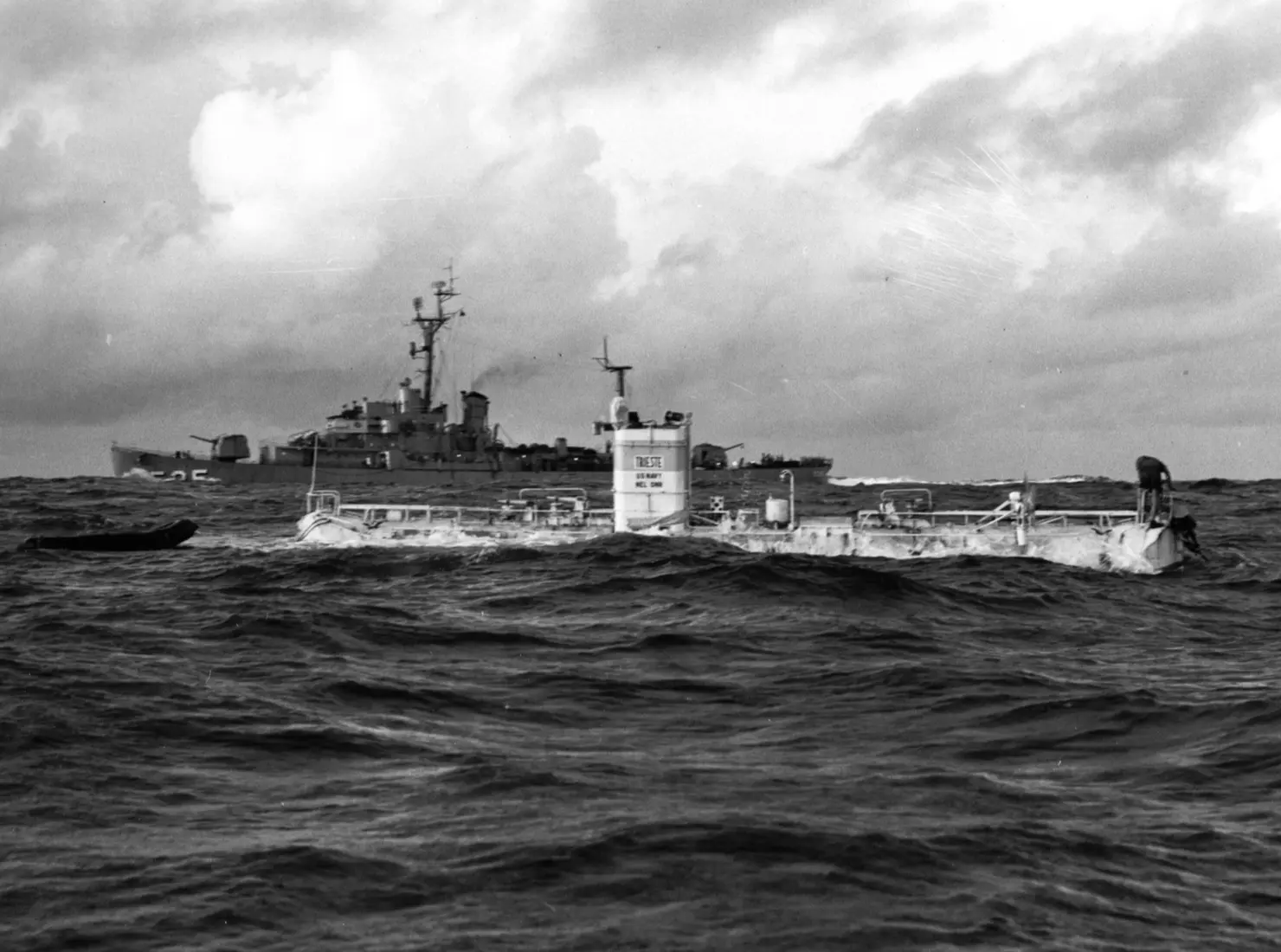
In the 1950s, the Swiss physicist Auguste Piccard designed a deep-diving craft unlike anything before it: a heavy steel sphere for the crew, slung under a huge float filled with gasoline. The project received major financial and technical support from people, institutions and companies in Trieste, while construction involved several Italian firms. The craft took the city's name in recognition of that support.
It didn't begin as a naval project or a government program. It was an artisanal machine — designed by Auguste Piccard, built with his son Jacques, refined dive after dive.
On January 23, 1960, Jacques Piccard — Auguste's son — and Don Walsh took the Trieste to the bottom of the Mariana Trench: Challenger Deep, about 10,916 meters down. The deepest known point of the world's oceans. No human went back for more than fifty years.
- Designed by
- Auguste Piccard
- Supported by
- the people, institutions and companies of Trieste — hence the name
- Piloted by
- Jacques Piccard & Don Walsh
- Destination
- Challenger Deep, Mariana Trench
- Depth
- ~10,916 m — January 23, 1960
- Next crewed dive
- more than fifty years later
This app's default color theme is called Mariana. The name Trieste recalls the bathyscaphe that reached the bottom of the Mariana Trench.
Built by someone who uses it every day
Trieste grew out of a practical need. Its author worked with coding agents all day, switching constantly between their conversations and a code editor. As the number of agents grew, it became harder to follow the work, spot what needed attention, and keep track of important decisions.
Trieste brings together file reading, sharing references with agents, following conversations, and reviewing changes. Its author uses it every day and has added a browser, a terminal, a phone remote, and scheduled agents. It's available to anyone facing the same difficulties.
A tool shaped by everyday use.